The Underground Network: How Trees Talk to Each Other Through Fungal Threads

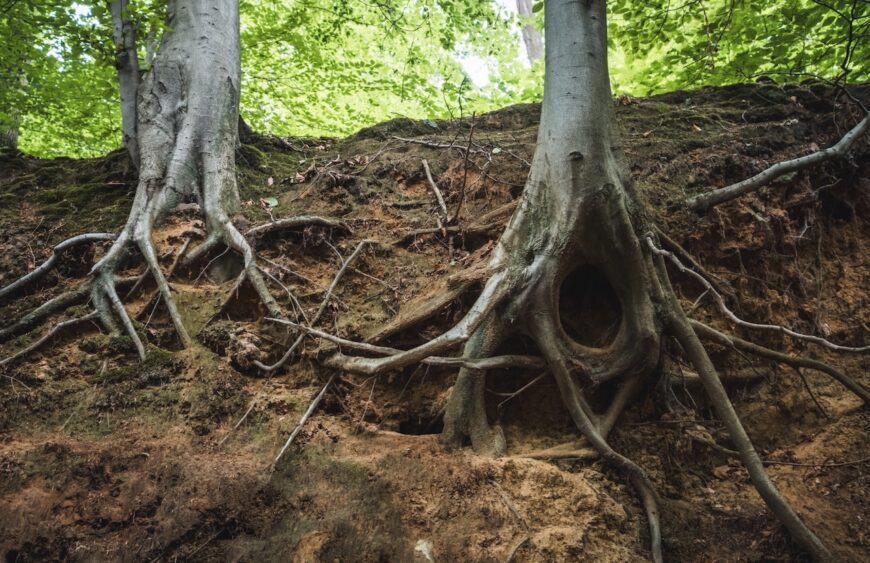
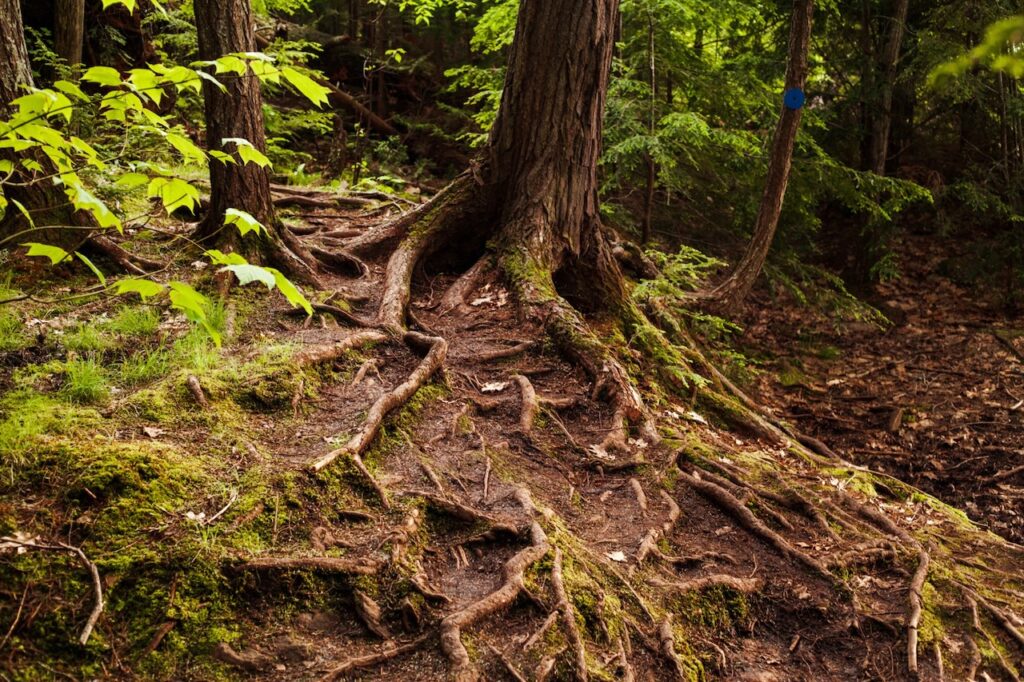
When you walk through a forest, you only see what stands above the soil — trunks, canopies, undergrowth. But the real life of the forest happens below, in a thin layer of earth where trees are linked by a dense web of fungal threads that scientists have nicknamed the Wood Wide Web — the forest’s own internet. It is through this underground infrastructure that trees exchange carbon, water, and warning signals, and that older trees can even feed young seedlings growing in their shade.
In this article, we explain what mycorrhiza is, how the fungal network connecting tree roots actually works, and why protecting it matters just as much as planting new trees. It is a topic that changes how we see a forest — from a loose collection of individual plants into a single, cooperating organism.
What Mycorrhiza Is and How the Forest Network Forms
Mycorrhiza is a symbiotic relationship between plant roots and soil fungi, beneficial to both partners. The fungus wraps around or grows into root cells, forming a branching network of thin filaments called hyphae, which together make up the mycelium. These hyphae are far thinner and longer than even the finest root hairs, allowing the fungus to explore a soil volume many times larger than the tree’s own roots and to reach water and minerals the plant could never access on its own.
In exchange for these resources, the tree supplies the fungus with sugars produced through photosynthesis — a compound the fungus cannot make itself. Crucially, this exchange rarely stays confined to a single tree-fungus pair. The very same fungal threads often connect to the roots of many different trees, even different species, forming one extensive, shared network beneath an entire stretch of forest.
Two Main Types of Mycorrhiza
In temperate forests, two types of this symbiosis dominate:
- ectomycorrhiza — the fungus wraps a sheath of hyphae around the outside of the root, typical of oaks, beeches, pines, and birches;
- endomycorrhiza (arbuscular mycorrhiza) — the hyphae penetrate directly into root cells, more common in maples, ash trees, and most herbaceous plants.
Both types serve the same basic function: linking an individual tree into a wider network through which the resources of the entire ecosystem circulate.
How Trees “Talk” Through the Underground Network
Research conducted since the 1990s, notably by Canadian forest ecologist Suzanne Simard, revealed something that once seemed impossible: trees connected by a shared mycelium exchange not only nutrients but also information. When one tree comes under insect attack, it can send chemical signals through the network that reach neighboring trees and trigger them to ramp up defensive compounds in advance, before the pest ever arrives at their doorstep.
Scientists have also documented carbon flowing between trees of different species — for instance, from a large birch to a fir growing in its shade, particularly when the fir has limited access to sunlight. In summer, surplus carbon from a fully leafed birch can support the slower-growing fir beneath it, while in autumn, once the birch sheds its leaves, the direction of flow can reverse.
Mother Trees and Care for the Next Generation
One of the most moving discoveries concerns the role of so-called mother trees — the largest, oldest specimens in a given forest patch, connected to dozens or even hundreds of other trees through a shared mycelial network. Studies have shown that mother trees can recognize their own offspring among seedlings growing nearby and direct greater amounts of carbon and nitrogen to them than to unrelated plants. When a mother tree becomes sick or begins to die, it may even transfer part of its remaining resources into the network before it dies completely — a final “gift” to the next generation.
The Forest’s Economy — Resource Exchange in the Underground Network
The mycorrhizal network is increasingly compared to an economic system in which resources flow toward wherever they are needed most. Fungi, while not conscious in any human sense, effectively “direct” carbon and water toward trees in poorer condition, because doing so expands the total root surface they can partner with — and therefore their own chances of survival.
Among the most important resources circulating through the network are:
- carbon, in the form of sugars, passed from trees producing a surplus to those in shade or under stress;
- nitrogen and phosphorus, gathered by the mycelium from distant pockets of soil and delivered to trees that could never reach them alone;
- water, transported from deeper, moister soil layers during periods of drought;
- chemical signals warning of pests, pathogens, or environmental stress.
Through this exchange, a forest functions less like a collection of competing individuals and more like a single, distributed organism — although, of course, competition for light and resources continues to exist alongside this cooperation.
Threats to the Fungal Network
The mycorrhizal network is surprisingly fragile, even though it can stretch across entire hectares of forest. Several factors damage it particularly severely:
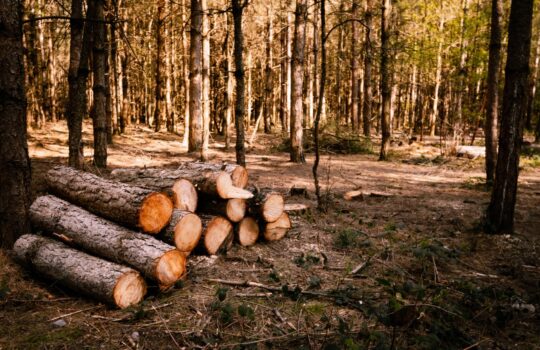
- large-scale clear-cutting — removing mother trees and severing the continuity of the mycelium leaves new plantings starting essentially from zero, without the support of an existing network;
- forest monocultures — plantations of a single tree species, all the same age, limit the diversity of mycorrhizal fungi and weaken the resilience of the whole system;
- excessive use of synthetic fertilizers — when a plant has easy access to nitrogen and phosphorus from fertilizer, it “pays off” less to invest in its relationship with fungi, which weakens the network over time;
- soil compaction and pollution — these limit the space in which mycelium can grow and disrupt the chemical processes the symbiosis depends on.
Why Old Forests Are So Hard to Recreate
This is exactly why planting new trees on the site of a felled old-growth forest does not restore it for decades. A mycorrhizal network is built over years, sometimes centuries, alongside the trees that create it. A forest made up of mature, interconnected trees and a rich, diverse mycelium is a fundamentally different ecosystem from a young planting on the same plot — even if the number of trees is identical.

How Tree Planting Can Help Rebuild the Underground Network
The good news is that responsible, thoughtful tree planting genuinely helps rebuild mycorrhizal networks, especially when plantings:
- combine several tree species growing together, which supports greater diversity of mycorrhizal fungi;
- leave old root fragments and deadwood in the soil, which can become a starting point for new mycelium;
- avoid excessive use of synthetic fertilizers and soil pesticides;
- protect any remaining mature trees near new plantings as a natural source of mycorrhizal fungi.
At our foundation, we try to design plantings with these relationships in mind — planting several species together so that, over time, they can build their own diverse network of underground support. You can read more about our approach to forest planting on the One More Tree website, where we describe the principles guiding our choice of sites and species.
What You Can Do in Your Own Garden
The principles that protect mycorrhiza work not only in forests but also in a home garden or allotment. If you want to support the underground life of your soil, it helps to:
- limit digging and tilling, which physically tears mycelial threads apart;
- plant a variety of species instead of a monoculture lawn;
- cut back or eliminate synthetic fertilizers, giving plants a reason to build relationships with fungi;
- leave leaf litter and deadwood on the soil surface rather than removing it — it serves as natural food for mycelium.
Why It Matters for the Whole Ecosystem
A healthy fungal network in the soil translates into richer soil that retains water better and resists drought and erosion more effectively. It is the foundation on which the rest of the ecosystem depends — from plants, to insects, to birds and larger animals. By caring for mycorrhiza, we are caring for something far bigger than a single tree.
A Forest as One Connected System
Discoveries about mycorrhizal networks are reshaping how scientists — and all of us — should think about a forest. Rather than a collection of individually competing trees, a forest turns out to be a densely interconnected system of interdependence, in which an individual’s survival often depends on the health of the whole network. This perspective carries far-reaching consequences for how we plan plantings, manage commercial forests, and protect the remaining fragments of old-growth woodland.
We invite you to explore this invisible world beneath your feet on your next walk in the forest. Visit our educational articles to learn more about the mechanisms that govern nature, and join our tree-planting efforts — every new tree is a potential new node in the underground network that will support the whole forest for decades to come.
Related Articles
Categories
Recent Comments
Recent Posts
Tags
animal protection biodiversity climate change consumer's rights Consumerism consumism CSR eco education ecological education ecology educational workshops electronics employee volunteering employer responsibility environment environmental protection event-cleaning event-education event-flowers event-trees event-volounteering event-volunteering flower meadow global warming green pulse of silesia labour law mental health natural environment nature phenology planting-event planting_event production process recycling repair services smartphone spring Stellantis sustainability trash tree planting trees waste segregation well-being workplace