Plant one million trees with us!
Articles

From Slag Heap to Forest: How Afforesting Post-Mining Land Gives Nature Back What Industry Took

wyr 3

Mining coal, sand, gravel, or metal ore leaves marks on the landscape that are hard to miss — vast overburden heaps, deep open pits, land stripped of fertile topsoil across tens, sometimes hundreds of hectares. For decades, such places were treated as lost to nature, an unavoidable side cost of industrial development. Today we know that even the most severely degraded post-mining site can, with the right approach, be turned into a forest full of life.

In this article, we explain what forest reclamation of post-industrial land actually involves, why it is far more difficult than ordinary tree planting, which species are the first able to colonize barren ground, and what the whole journey looks like from a bare heap of rock to a maturing forest ecosystem. It is a topic that shows the boundary between industrial land and nature does not have to be permanent.

What Post-Mining Land Reclamation Is and Why It’s a Challenge

Reclamation is the umbrella term for the technical, biological, and organizational measures aimed at restoring usable or ecological value to degraded land. For post-mining sites — areas left behind by open-pit extraction of lignite, sand, gravel, stone, or metal ore — forest reclamation is one of the most commonly chosen paths, alongside agricultural reclamation or reclamation into water bodies formed in former pits.

What sets forest reclamation apart from ordinary tree planting on existing soil is the starting point. Post-mining land rarely offers natural, fertile soil — far more often it is overburden, the rock and mineral layers removed to reach the deposit, stripped of humus, soil microorganisms, and the natural structure that soil takes thousands of years to build.

Types of Post-Industrial Sites Requiring Reclamation

In Poland and around the world, forest reclamation is most often needed on:

  • Overburden heaps from open-pit lignite mines, where removed earth and rock form artificial hills that can reach several dozen meters in height.
  • Pits left by sand and gravel extraction, often with steep, unstable slopes and extremely poor, highly permeable substrate.
  • Heaps from hard coal mining, sometimes containing substances that require additional neutralization before planting can begin.
  • Former quarry sites, where the exposed bedrock contains virtually no nutrients available to plants.

Why the Ground on Heaps and Pits Is Such a Difficult Environment for Plants

Post-mining substrate differs from natural forest soil in almost every respect that matters for plant growth. It lacks the humus built up over years through the decomposition of organic matter, meaning minimal available nitrogen, phosphorus, and other nutrients. The structure of such ground is often either excessively compacted, hindering root and water penetration, or the opposite — too loose and permeable, so that rainfall drains away quickly without reaching the surface root zone.

An additional challenge is often the pH level, which can deviate significantly from what most tree species need — some post-mining heaps are strongly acidic due to the oxidation of sulfur compounds, while others are markedly alkaline. The lack of plant cover also leaves the surface of heaps far more exposed to wind and water erosion than land covered by natural vegetation, making it even harder to maintain any fertile layer, even one applied artificially.

Stages of Forest Reclamation — From Securing the Site to a Mature Forest

The transformation of a heap into a forest usually takes several decades and unfolds in several clearly distinct phases, each requiring a different technical and biological approach.

  1. Technical reclamation — shaping the terrain, profiling slopes to a safe gradient, applying a layer of fertile soil or a soil substitute where needed, and protecting against erosion.
  2. Introducing pioneer vegetation — sowing grasses and nitrogen-fixing legumes that stabilize the surface and gradually enrich the substrate with organic matter.
  3. Planting pioneer tree and shrub species, resistant to poor, unstable conditions, which form the seed of the future stand.
  4. Gradually introducing target species, appropriate to the region, as soil conditions improve thanks to the earlier stages.
  5. Years of maintenance and monitoring, including replacing losses, protecting against pests, and observing how the developing stand affects local microclimate conditions.

Although these stages are often separated for the sake of technical documentation, in practice they overlap considerably — maintenance of pioneer plantings continues in parallel with preparing further areas for target species, and monitoring runs from the very start of the process.

Pioneer Species — The First Colonizers of Barren Ground

Pioneer species play a crucial role in the whole process — plants able to survive and grow in extremely poor conditions where most other species would simply die off. Among trees, these include silver birch, grey alder, and Scots pine, all capable of growing on soils too poor for many other species. Alder is especially valuable here, since its symbiosis with nitrogen-fixing bacteria allows it to literally enrich the ground it grows in, preparing the soil for more demanding species that will follow.

Examples of Successful Forest Reclamation in Poland and Around the World

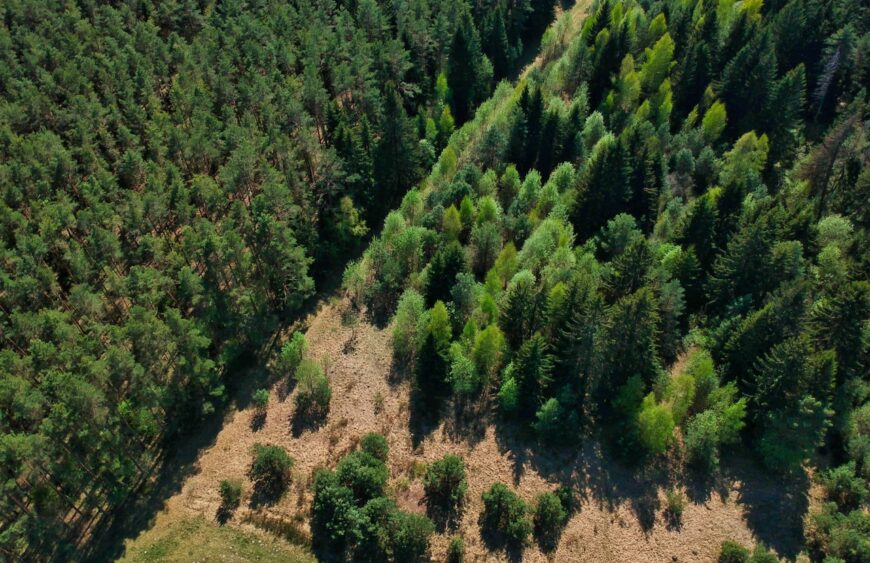
Poland has numerous examples of post-mining sites that, over several decades, have turned into fully functioning forest ecosystems. Land around former open-pit lignite mines in Greater Poland and Lower Silesia, after years of systematic reclamation, is today covered by pine and mixed forests home to roe deer, hares, and numerous bird species, with some of these areas having gained protected status.

Similar processes can be observed worldwide — in Germany’s Lusatia region, former lignite mines have been transformed into a mosaic of forests and artificial lakes, creating an extensive recreational and natural area known as the Lusatian Lakeland. This shows that the scale of degradation, however overwhelming at first glance, does not mean a site is lost forever — it simply requires a much longer time horizon and a more complex approach than standard planting.


The Role of Species Diversity in the Durability of Reclaimed Forests

Early forest reclamation projects, carried out in the second half of the 20th century, often relied on monocultures — most commonly pine, as the species easiest to establish on poor ground. Today we know that this approach, though effective in the short term, produces a forest far more vulnerable to disease, pests, and the effects of climate change than a species-diverse stand.

That is why modern reclamation projects favor the gradual introduction of mixed stands, combining pioneer species with target broadleaf species suited to the region’s natural conditions. Such diversity not only increases the ecosystem’s resilience to disturbance, but also restores conditions favorable to the return of forest floor vegetation, fungi, and the whole web of relationships between organisms that characterizes a natural, mature forest, much faster.

Challenges and Limits of the Reclamation Process

Despite numerous successes, forest reclamation of post-mining land has clear limitations worth keeping in mind, so it isn’t treated as a universal fix for land degradation. Even after several decades, a forest restored this way still differs from a natural forest in soil structure, microbiome composition, and the species richness of its understory — fully “catching up” with a natural ecosystem may take far more than a single generation of trees.

The cost of such projects is also often measured in time — the forest reclamation process stretches across decades, which complicates funding and requires sustained commitment from the institutions responsible for the site, regardless of changes in ownership or politics. That is why effective reclamation requires cooperation between mining companies, local governments, scientists, and non-governmental organizations already at the stage of planning a deposit’s extraction, not only once it has been exhausted.

What’s Next for Post-Industrial Land

Forest reclamation of post-mining land is one of the most tangible proofs that humanity’s relationship with nature does not have to be a one-way process. Places that served resource extraction for decades can, with the right planning and patience, become home to wildlife, a recreational space for residents, and a genuine contribution to the fight against climate change through carbon sequestration.

By supporting tree-planting efforts, including those carried out on land that needs special attention, each of us can help ensure that more degraded fragments of the landscape get this same second chance. We encourage you to explore our tree-planting projects and our educational articles, where we regularly write about how nature can reclaim even the most human-altered land.

protected by reCAPTCHA Privacy Terms