Bark Beetles and Tree Diseases in a Changing Climate: Why Weakened Forests Lose Their Resistance

For decades, the European spruce bark beetle (*Ips typographus*) was a familiar part of Central European forests — a tiny insect that mostly attacked old, sick, or wind-thrown spruce trees. Today, that same species has become a clear symbol of the climate crisis unfolding across Europe’s woodlands. Repeated heatwaves, multi-year droughts, and increasingly mild winters have upset the balance between tree and pest, handing the beetle an advantage it never had before.
This article explains why climate-weakened forests become easy targets for insects and pathogens, how the biology of the bark beetle and other tree threats works, how severe the crisis has become across Central Europe, and why the debate over managing infested forests now divides foresters, scientists, and conservationists.
What Is the Bark Beetle? The Biology of a Tiny but Formidable Pest
The bark beetle is a surprisingly small insect, just 4–5.5 mm long, belonging to the weevil family. Its name comes from the distinctive pattern of galleries it carves beneath spruce bark, resembling printed type. Females lay eggs along a central maternal gallery, and hatching larvae feed outward, severing the tree’s phloem — the living layer that transports nutrients — and effectively cutting the crown off from the roots.
The beetle attacks almost exclusively Norway spruce (*Picea abies*). Central to its strategy is the mass attack: the first beetles to find a suitable tree release aggregation pheromones that draw thousands of others within days. This coordinated swarm can overwhelm even a healthy tree, though a single insect stands no chance alone. The beetle rarely acts solo — it also carries spores of *Ophiostoma* fungi, causing blue-stain fungal infection, which further blocks water transport and hastens the tree’s decline.
Resin: The Tree’s Shield, and Why Drought Breaks It
A healthy conifer defends itself with resin: when a beetle bores into the bark, the tree floods the wound with sticky resin, physically pushing the intruder out — the source of the tell-tale “pitch tubes” on an infested trunk. Resin also contains terpene compounds toxic to both beetles and the fungi they carry, making it a chemical weapon as much as a physical barrier.
Producing resin, however, is energetically costly and requires well-hydrated tissue. During prolonged drought, a tree closes its stomata to conserve water, cutting photosynthesis and the carbon available for chemical defence. A thirsty tree must choose between survival and defence — and defence usually loses. Research across Central Europe and North America confirms that climatic water deficit is among the strongest predictors of beetle-induced tree mortality: it is the combination of drought and pest pressure, not the beetle alone, that kills a forest.
Warmer Winters, More Generations: How Heat Speeds Up Beetle Reproduction
Beetle development depends on accumulated warmth — the hotter it gets, the faster larvae pass through each stage. A few decades ago, Central European populations typically completed one, occasionally two, generations per season. Today, with longer growing seasons, two full generations a year are common, and in warmer regions even three occur. Some females also produce “sister broods” — a second clutch instead of winter dormancy — while milder winters raise the survival rate of overwintering beetles.
The combination of extreme events is particularly dangerous. Powerful storms that snap or uproot trees hand the beetle an enormous supply of fresh breeding material. If several years of drought follow, the population that multiplied on fallen trunks moves on to living but weakened stands — triggering the kind of population explosion observed across much of Central Europe in recent years.
The Scale of Spruce Forest Dieback in Central Europe
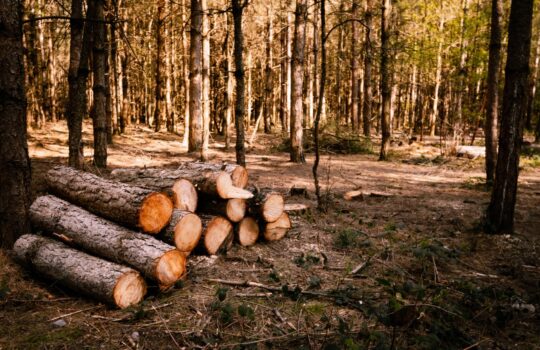
The past decade has brought an unprecedented wave of spruce dieback across the Czech Republic, Germany, Austria, Slovakia, and Poland. After a run of hot, dry years combined with severe windstorms, foresters have had to carry out sanitary logging on a scale not seen in decades, removing millions of cubic metres of infested timber. In parts of the Czech mountains and Saxony, entire stretches of long-established spruce plantations disappeared within just a few years.
Poland, though affected on a smaller scale, has also seen intensified dieback — particularly in the Sudetes, the Carpathians, and lowlands where artificial spruce monocultures grow outside their natural range. These very monocultures, planted en masse in the 19th and 20th centuries for fast growth, prove the most vulnerable today: chronically stressed by growing outside optimal conditions, they have limited defensive capacity even without added drought.
The Białowieża Forest as an Example of the Bark Beetle Dispute
The symbol of Poland’s bark beetle controversy became the Białowieża Forest, where a 2016–2018 decision to sharply increase logging, justified as a response to an outbreak, triggered pushback from scientists and intervention from the Court of Justice of the EU. That dispute illustrates how hard it is to reconcile competing visions of forest management in the face of a pest outbreak — a theme we return to below.

Beyond the Bark Beetle: Other Pests and Diseases on the Rise
The bark beetle is the most widely reported threat, but far from the only one gaining ground as the climate warms. European forests today face a whole spectrum of pests and pathogens:
- Armillaria root rot — fungi that attack stressed trees of many species and destroy the root system from within, often unnoticed until the tree falls.
- Ash dieback — caused by the fungus *Hymenoscyphus fraxineus*; drought-weakened trees cope far worse with infection.
- Dutch elm disease — spread by other bark beetle species, has eliminated mature elms from many European cities and floodplain forests.
- Pine processionary moth — a heat-loving moth with urticating larvae, whose range shifts steadily northward as the climate warms.
- Six-toothed bark beetle and other Ips species — smaller relatives that also multiply their generations under favourable conditions.
What unites these threats is that they rarely succeed against healthy, well-hydrated trees. It is climate stress that opens the door, lowering natural resistance and making trees an easier target — a broader syndrome of forest weakening rather than isolated “pest of the year” events.
To Cut or Let Nature Take Its Course? The Forest Management Debate
When an outbreak strikes a stand, foresters face a genuine dilemma. Advocates of prompt sanitary logging argue that removing infested trees before the next generation emerges is the only effective way to slow an outbreak and protect neighbouring stands. There is also an economic dimension: timber loses commercial value once blue-stain fungi discolour it.
Ecologists counter that in forests of high conservation value, outbreaks are a natural process that has shaped forest structure for millennia. Dead spruce trees become habitat for woodpeckers and fungi, and natural succession often rebuilds a more diverse, resilient forest. In practice, more foresters now favour a tailored approach: production forests still see rapid removal of infested trees, while reserves and national parks increasingly leave dead wood to natural processes.
Adaptive Forestry: Monitoring, Restructuring, and the Road Ahead
The forestry sector’s response is an increasingly systematic approach known as adaptive forestry, centred on early detection before an outbreak reaches an unmanageable scale. In practice, this includes:
- Regular inspections for entry holes, sawdust-like frass, and characteristic needle discolouration.
- Monitoring beetle flight with pheromone traps to anticipate activity peaks.
- Satellite and remote-sensing analysis, increasingly AI-supported, detecting water stress before it is visible from the ground.
- Rapid removal of infested trees before the next generation can emerge and fly.
More forest districts are also opting for gradual restructuring — replacing beetle-vulnerable spruce monocultures with diverse species mixes suited to local conditions. This demands decades of patience, since forests grow far more slowly than the climate is changing, but it is now regarded as the most effective long-term strategy for building resilience.
What This Means for the Future of Europe’s Forests
The crisis surrounding the bark beetle is not a temporary anomaly — it is a preview of the new normal in a changing climate. Scientists project that pest and pathogen pressure on European forests will keep growing as temperatures rise and droughts become more frequent. How we plant and tend our forests today will determine what forest landscapes look like for our children and grandchildren.
The good news is that we are not powerless. Thoughtful planting choices, species and age diversity, and support for natural regeneration are all actions anyone can support. This is why One More Tree Foundation works on planting trees suited to local conditions and on environmental education, showing that a forest’s resilience begins with a deliberate choice of species and site.
Conclusion: Forest Resilience Begins with Diversity
The story of the bark beetle reminds us that everything in nature is interconnected — climate, soil water balance, the condition of a single tree, and the fate of entire ecosystems. Drought-weakened trees lose their capacity for self-defence, milder winters give pests a numerical edge, and monocultures planted decades ago for quick profit now pay the highest price for their lack of diversity.
If you want to help build more resilient, diverse forests, join our efforts and support tree planting with the One More Tree Foundation. Every tree planted in the right place is a small but real step toward forests able to withstand a changing climate. We also invite you to explore our environmental education resources to better understand what is happening in Europe’s forests today.
Related Articles
Categories
Recent Comments
Recent Posts
Tags
animal protection biodiversity climate change consumer's rights Consumerism consumism CSR eco education ecological education ecology educational workshops electronics employee volunteering employer responsibility environment environmental protection event-cleaning event-education event-flowers event-trees event-volounteering event-volunteering flower meadow global warming green pulse of silesia labour law mental health natural environment nature phenology planting-event planting_event production process recycling repair services smartphone spring Stellantis sustainability trash tree planting trees waste segregation well-being workplace